


Pole Barn ROI: What Adds the Most Property Value?
May 5, 2026
If you're researching whether a pole barn adds value to your property, you've probably noticed that the answers online can skew from "absolutely" to "it depends" to "not as much as you think." All three of those answers are technically correct, which isn't very helpful. The real problem is that most people ask the right question but use the wrong mental model to evaluate the answer.
Pole barn ROI doesn't work like kitchen renovation ROI. The numbers are more variable, the appraisal process is less standardized, and the gap between what a barn costs to build and what it contributes to your appraised value can be significant. Understanding why the gap exists, and when it matters less than you'd expect, is the foundation for making a clear-headed decision.
 How a lender classifies a pole barn affects what a buyer can borrow, which in turn affects what buyers can offer for your property. Some lenders treat pole barns as outbuildings rather than improvements, which means the barn's value may not count toward the loan collateral. FHA and USDA loan programs have specific guidelines about agricultural structures on residential properties, which can limit your buyer pool to conventional or cash buyers. A buyer who cannot finance the full purchase price because of the barn’s classification may offer less money, even if they personally highly value the structure.
Q: Does a pole barn show up on a home appraisal?
Yes, appraisers include pole barns in their property assessment. The barn will appear as an accessory structure or outbuilding. Whether it adds measurable contributory value depends on whether the appraiser can find comparable sales of similar properties with similar structures in your market. If there are no (or few) comps, the appraiser will use the cost approach, which typically yields a lower value than construction cost.
How a lender classifies a pole barn affects what a buyer can borrow, which in turn affects what buyers can offer for your property. Some lenders treat pole barns as outbuildings rather than improvements, which means the barn's value may not count toward the loan collateral. FHA and USDA loan programs have specific guidelines about agricultural structures on residential properties, which can limit your buyer pool to conventional or cash buyers. A buyer who cannot finance the full purchase price because of the barn’s classification may offer less money, even if they personally highly value the structure.
Q: Does a pole barn show up on a home appraisal?
Yes, appraisers include pole barns in their property assessment. The barn will appear as an accessory structure or outbuilding. Whether it adds measurable contributory value depends on whether the appraiser can find comparable sales of similar properties with similar structures in your market. If there are no (or few) comps, the appraiser will use the cost approach, which typically yields a lower value than construction cost.
How Appraisers Actually Value a Pole Barn
Appraisers don't assign a flat dollar amount to a pole barn. What they measure is called contributory value. Contributory value is the dollar amount a specific feature adds to the total property value, measured by comparing similar properties with and without that feature in the same market. If nearby properties with pole barns consistently sell for $25,000 more than comparable properties without them, the appraiser has data to support a $25,000 contributory value for your barn. The challenge is that appraisers need comparable sales to do this analysis. Pole barns are not standard residential features, so in many markets, comparable sales are hard to find or nonexistent.The Comparable Sales Problem
When appraisers cannot find enough comparable sales of properties with similar pole barns, they fall back on the cost approach. The cost approach estimates its value based on the cost to reproduce the structure, minus depreciation. This method almost always produces a lower contributory value than the owner paid to build, sometimes significantly lower. A barn that costs $50,000 to construct might receive a contributory value of $28,000 to $38,000 under the cost approach, because the market data to justify a higher number doesn't exist in that area. This difference is not the appraiser being conservative arbitrarily. Fannie Mae and Freddie Mac guidelines for outbuildings require appraisers to support contributory value with market evidence. Without comps, the cost approach is the defensible methodology.What "Contributory Value" Actually Means
Contributory value is not the same as replacement cost. A $40,000 pole barn does not automatically add $40,000 to your appraised value. The barn contributes only what the market recognizes, and the market recognizes only what buyers in your area have demonstrated they will pay a premium for. In rural farm markets, that recognition can be strong. In suburban markets, it is often weak or absent. Pole barns are classified as accessory structures rather than habitable space. This classification limits how much value an appraiser can formally assign relative to construction cost because the comp pool for accessory structures is smaller and more variable than that for finished living square footage. Key Takeaway: Pole barn value is not determined by what you paid to build it. It is determined by what similar properties with similar barns have sold for in your specific market. If that data doesn't exist locally, the appraiser will use the cost approach, which is typically lower than the construction cost.What Pole Barn ROI Actually Looks Like in Numbers
Most pole barn owners could recoup somewhere between 50% and 80% of the build cost in appraised value. That range is wide because the variables are wide. A basic unfinished storage barn in a rural market with strong agricultural demand might hit the upper end of that range. A finished pole barn with custom interior features in a transitional suburban market might fall well below it. According to the annual Cost vs. Value Report, detached garages, the closest standard comparison, return approximately 65 to 80 percent of their construction cost at resale, depending on the region. Pole barns have a wider variance than garages because their buyer pool is narrower and more context-dependent. The distinction worth understanding here is the difference between appraised value and market sale price. These two numbers can diverge significantly for pole barn properties, and the gap between them is where much of the real ROI is.Appraised Value vs. Market Sale Price
A buyer who specifically needs a pole barn for livestock, equipment storage, or a workshop will often pay a premium that the appraiser cannot formally justify through comps. If the buyer is purchasing with cash or accepting a higher loan-to-value ratio, the appraised value becomes less of a ceiling on what they'll offer. In these situations, the market sale price can exceed the appraised value, and the barn's true ROI ends up higher than the appraisal alone would suggest. This dynamic is why rural properties with functional outbuildings in agricultural regions often sell faster and at stronger price-per-acre figures than comparable bare land.A Baseline Benchmark Table
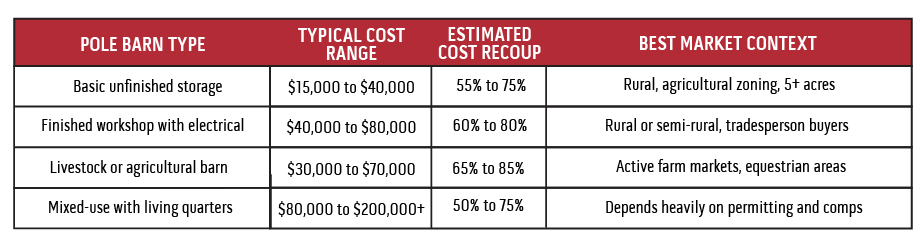
Pole barn costs typically range from $15 to $45 per square foot for basic post-frame construction, while finished or climate-controlled projects may exceed that range depending on scope, region, and materials. Costs can vary significantly by project. HomeAdvisor is a good place to start if you're looking for local data. The table below provides rough cost-recoup ranges by barn type and buyer profile.
Features That Meaningfully Increase Pole Barn Value
The features that move the needle on appraised contributory value and buyer willingness to pay share a common trait: they expand what the barn can do. Appraisers and buyers reward function. They rarely reward aesthetics at full cost. The four features that consistently produce measurable value improvements across markets are insulation, concrete flooring, proper electrical service, and permitted construction. Each of these expands the barn's usable function and reduces a future buyer's capital outlay to make the structure work for their needs.Permitted and Inspected Construction
A pole barn built with permits will appraise and sell differently than one built without. Lenders, appraisers, and buyers all treat unpermitted structures as potential liability rather than confirmed assets, regardless of actual build quality. Permitted construction signals that the structure complies with local building codes, which is relevant to both appraisers assigning value and lenders approving loans. This single factor has more impact on resale than most finish upgrades.Functional Finish vs. Aesthetic Finish
The distinction between functional upgrades and aesthetic upgrades is critical for managing pole barn investment. Insulation is a functional upgrade because it enables year-round use for workshops, livestock, and temperature-sensitive equipment. A 200-amp electrical panel is functional because it powers tools, equipment, and lighting that define the barn's utility. Concrete flooring is functional because it supports vehicle storage and heavy equipment use that dirt floors cannot. Upgraded exterior paint, decorative trim, high-end lighting fixtures, and custom color packages are aesthetic upgrades. Buyers notice them, but they do not change what the barn can do. Appraisers assign value based on function and comp support, not on appearance alone.Upgrades the Market Largely Ignores
Interior cosmetic finishes, custom color packages, high-end lighting, and specialty flooring rarely recoup their cost in a pole barn appraisal. Themed interiors, man-cave builds, and custom décor packages are personal-use investments. They may add significant enjoyment to your ownership experience, but they do not translate to appraised contributory value in a predictable way.The Personalization Trap
Highly customized barn interiors can reduce your buyer pool rather than expand it. A buyer who has no use for a sports bar setup, a recording studio finish, or a very specific livestock configuration sees removal cost, not added value. The more specialized the interior, the smaller the group of buyers for whom that investment reads as a benefit. Over-customization is one of the most consistent sources of post-sale disappointment for pole barn owners. The expectation is that quality and effort translate to market value. In reality, market value follows buyer demand, and buyer demand is a function of how many people in your area need what your barn offers. Custom features narrow that group.Pole Barn vs. Garage for Resale Value
In suburban and transitional markets, an attached or detached garage almost always outperforms a pole barn for appraised value and buyer universality. Garages are standard residential features. They have deep comp pools, predictable contributory values, and broad buyer appeal because almost every buyer can use a garage. In rural and agricultural markets, a functional pole barn frequently outperforms a similarly priced garage because it better matches what buyers need. A two-car garage does not store a tractor, hay, or livestock. A 40x60 pole barn does. The right answer depends entirely on who is likely to buy your property.What Lenders See Differently
How a lender classifies a pole barn affects what a buyer can borrow, which in turn affects what buyers can offer for your property. Some lenders treat pole barns as outbuildings rather than improvements, which means the barn's value may not count toward the loan collateral. FHA and USDA loan programs have specific guidelines about agricultural structures on residential properties, which can limit your buyer pool to conventional or cash buyers. A buyer who cannot finance the full purchase price because of the barn’s classification may offer less money, even if they personally highly value the structure.
Q: Does a pole barn show up on a home appraisal?
Yes, appraisers include pole barns in their property assessment. The barn will appear as an accessory structure or outbuilding. Whether it adds measurable contributory value depends on whether the appraiser can find comparable sales of similar properties with similar structures in your market. If there are no (or few) comps, the appraiser will use the cost approach, which typically yields a lower value than construction cost.
When Location Changes Everything About ROI
Pole barn ROI is not a fixed number. It depends on how deep the buyer pool is in your specific market. A pole barn on 10 acres in a farm county has a large group of buyers who will pay for it. The same structure on a half-acre suburban lot can have less. Location is the variable that overrides every other factor in this analysis. Regions with strong demand for hobby farming, equestrian activity, or small-scale agriculture produce the strongest pole barn value premiums. The Mountain West states, the Midwest, and the rural Southeast consistently show markets where working barns are expected and priced accordingly.Reading Your Local Buyer Pool
A quick way to assess whether your market supports pole barn value is to search active listings and recent sales on Zillow or your local MLS and filter for properties with barns or outbuildings. If those properties sell at a visible premium and move quickly, your market has buyer demand. If they sit or sell the same as properties without pole barns, adding one is unlikely to command a meaningful premium. A 15-minute conversation with a local appraiser or a few rural real estate agents will give you more reliable market intelligence than a national average.Unpermitted Structures and Lender Flags
When a buyer's lender discovers an unpermitted pole barn during underwriting, the most common outcomes are: the lender requires the structure to be permitted before closing; the lender excludes the structure's value from the loan collateral; or, in some cases, the lender requires its removal. Any of these outcomes can delay or kill a sale. This example is the most common way a pole barn could potentially hurt a transaction rather than just underperform on ROI. Cash buyers are not subject to lender underwriting, but they are a smaller pool, which reduces your offers. Q: Can a pole barn hurt my home's appraisal? In most cases, no. A structurally sound, permitted pole barn that is appropriately sized for the property typically contributes neutral or positive value. The situations where a barn actively reduces appraised value are specific: unpermitted construction, zoning violations, visible structural deterioration, or a barn size that represents over-improvement relative to the surrounding market. Deferred maintenance, rust, sagging panels, or rotting posts can reduce the contributory value to near zero if severe enough.The Real Reason Most Pole Barns Are Worth It
Most pole barns are worth building not because they return dollar-for-dollar on the appraisal, but because they deliver years of functional value before any resale conversation happens. And in the right market, the premium a motivated buyer will pay for a barn that fits their exact use case can exceed what any formal appraisal model predicts. Every property is different. If you’re considering a pole barn, a quick conversation with a builder can help you understand costs, use, and potential resale impact before you commit. Talk with a specialist at Matador Structures to get started. The figures, ranges, and market observations in this article are based on publicly available data. They are intended as a general educational framework for understanding how pole barn value is evaluated, not as a guarantee of what your specific property will appraise for or sell at. Appraisal outcomes, lender classifications, and buyer demand vary significantly by region, property type, market conditions, and individual circumstances. Before making any decisions about building, financing, or selling a property with a pole barn, consult with a licensed appraiser familiar with rural and agricultural properties in your area, a qualified real estate professional with experience in your local market, and a licensed contractor or builder who can provide accurate cost estimates for your specific project and site.
Frequently Asked Questions About Pole Barn Property Value and ROI
Does a pole barn add value to your property?
Yes, but the amount depends on your location, buyer pool, and how the barn is built. In rural markets with strong demand, a functional pole barn can add meaningful contributory value and help a property sell faster. In suburban or transitional markets, the value is lower and less predictable. The single biggest factor is whether local comparable sales exist. Without comps, appraisers use the cost approach, which often values the barn lower than its construction cost.What percentage of a pole barn's cost can I expect to recoup at resale?
Some pole barn owners recoup somewhere between 50% and 80% of the build cost in appraised value, depending on barn type, finish level, and market context. (These numbers are estimates, since it varies so widely.) In many cases, owners may recover a portion of the build cost, while some rural properties with strong demand can outperform suburban markets. Basic functional barns often hold value better than highly customized builds. Unlike garages, pole barns tend to see wider resale swings because buyer demand is more location-specific.Does a pole barn need to be permitted to add value?
Yes. A properly permitted pole barn is generally easier to appraise, finance, and sell than an unpermitted one. Lenders, appraisers, and buyers may view unpermitted structures as added risk, even if the workmanship is solid. Depending on local rules and the lender, an unpermitted barn could require additional documentation, retroactive permits, repairs, or reduced recognition in the appraisal. Permitting is not optional if resale value matters.What features add the most value to a pole barn?
The features that expand what a structure can do consistently add the most value to a pole barn. Permitted construction, concrete flooring, proper electrical service and insulation that enables year-round use are all upgrades that appraisers and buyers value. These improvements make the barn more usable and reduce future upgrade costs for the next owner. Cosmetic upgrades like custom paint, decorative trim, and specialty lighting may improve appearance, but they often add less measurable resale value.What pole barn features does the market largely ignore?
Interior cosmetic finishes, custom color packages, themed interiors, high-end decorative lighting, and specialty flooring seldom recoup their cost in a pole barn appraisal. Highly personalized builds, like sports bar setups, recording studio finishes, or horse stall configurations, can reduce your buyer pool rather than expand it. Buyers who have no use for those features see removal cost rather than added value. The more specialized the interior, the smaller the group of buyers for whom that investment reads as a benefit.How does a pole barn affect a home appraisal?
Appraisers include pole barns in their property assessments as an accessory structure or outbuilding. How much value it adds depends on local comp sales, the barn’s condition, and whether it was properly permitted. If similar sales are limited, the appraiser may use the cost approach, which often values the barn below its original construction cost. A well-maintained, functional barn may add positive value, while an unpermitted or deteriorated structure can limit or reduce that value.Is a pole barn or a garage better for resale value?
It depends entirely on your market and the likely buyer. In suburban and transitional markets, an attached or detached garage almost always outperforms a pole barn for appraised value and buyer universality because garages are standard residential features with numerous comps and broad appeal. In agricultural markets, a functional pole barn frequently outperforms a garage because it better matches buyer needs. The right answer depends on who is most likely to buy your specific property.How do lenders treat pole barns when financing a property?
Lender treatment varies and can directly affect your buyer pool. Some lenders classify pole barns as outbuildings rather than improvements, which may limit how much value is recognized in the loan. FHA and USDA loan programs have specific guidelines regarding agricultural structures on residential properties, which can limit your buyer pool to conventional or cash buyers. If a buyer can’t finance the full purchase price because of the barn’s classification, they may offer less, even if they personally value the barn. This is an overlooked way that barn classifications can affect resale outcomes.Does location affect pole barn ROI more than any other factor?
Yes. Location is the variable that overrides nearly every other factor because it determines buyer demand. A pole barn on acreage in a farm county has a large group of potential buyers. The same structure on a half-acre suburban lot has far fewer. Regions with strong demand for hobby farming, equestrian activity, or small-scale agriculture often see stronger resale premiums. For the most accurate guidance, a local appraiser or real estate professional can offer better insight than stats showing national averages.



Customized Blast-Resistant Buildings

Lease-Ready Blast-Resistant Buildings

Portable Storage and Modular On-Site Offices

Hardened Structures for Defense & Security

Residential and Commercial Storm Shelters

Heavily Engineered, Industrial Quality Metal Pole Barns

Offshore Modular Solutions and Portable Technical Buildings